
A Five-Minute Paper Shutdown for the End of the Workday
A Five-Minute Paper Shutdown for the End of the Workday
How the studio ends the day before the day keeps ending itself.
Summary
The last five minutes of work are often the part we forget to design. A small paper shutdown can turn loose thoughts into a visible list, choose tomorrow's first move, and give the evening a cleaner edge.
Journal article
The workday rarely stops in one clean motion.
One more tab stays open. One small worry follows the calendar into the evening. A message from mid-afternoon still asks to be answered, even after the laptop is closed. The desk may be empty, but the mind is still sorting through what was left unfinished.
That is usually where the problem lives: not in the amount of work itself, but in the lack of a real end.
Recent work on digital wellbeing keeps saying something plain: constant connection has a cost. The 2025 Digital Wellbeing Report describes the strain of always being reachable. Research on digital mental health interventions in JMIR Mental Health and a 2025 study on employee wellbeing and digital technologies both suggest that screen-heavy work is not only a question of time. It is also a question of recovery. When contact keeps arriving in fragments, the body does not always get a clear signal that the day is over.
For introverts, that signal matters even more. A 2025 field study on remote workplace interactions and extraversion suggests that the texture of work interactions shapes experience, not only the number of hours spent in them. A day filled with small pings can feel heavier than the calendar suggests.
A paper shutdown is a way of answering that texture with something slower and more visible.
What a paper shutdown is
The studio keeps a small card for this. Not a planner. Not a to-do list that wants to become a moral record. Just a card that is allowed to be messy.
At the end of the workday, the card gets five minutes.
Five minutes is long enough to notice what is still open, but short enough that the ritual does not become another task to maintain. The point is not to finish everything. The point is to decide what is staying, what is waiting, and what is leaving the desk.
The paper part matters.
Writing by hand changes the pace. It makes the decision slightly heavier, which is useful when the brain is already trying to keep too many windows open. Research on drawing compared to writing in a diary found that drawing can improve recall of autobiographical events. A related study on drawing behaviour and thought patterns also suggests that the simple act of making a mark changes how attention gathers. These studies are not about shutdown rituals specifically, but they point to a useful truth: moving a thought onto paper changes the thought's shape.
That is all we need from them here.
The five-minute paper shutdown
1. Empty the open loops
Write every loose thread that is still trying to follow you home.
A reply that has not been sent. A file that needs naming. A bill. A question. A half-formed idea for tomorrow. Keep the list short and blunt. This is not the place for polish.
The value here is visibility. When unfinished work stays in the head, it keeps asking to be remembered. When it is on paper, it becomes something the page can hold for a while.
If one of those open loops has grown into a project with several moving parts, the Printable Project Tracker Insert keeps the tasks, priorities and progress together in one small spread.
2. Choose tomorrow's first move
Pick one thing that will make tomorrow easier to start.
Not the whole morning. Just the first move. Open the document. Draft the reply. Lay out the materials. Decide the first line.
This matters because a lot of work anxiety lives in the beginning. If the beginning is already named, the evening does not have to keep rehearsing it.
3. Mark what can wait
Write one line for everything that is not urgent.
Something like: The rest can wait until tomorrow. Or: No decision is needed tonight.
This line is the boundary. It is not a promise that nothing will be missed. It is a decision that the rest of the day does not need to keep negotiating with you.
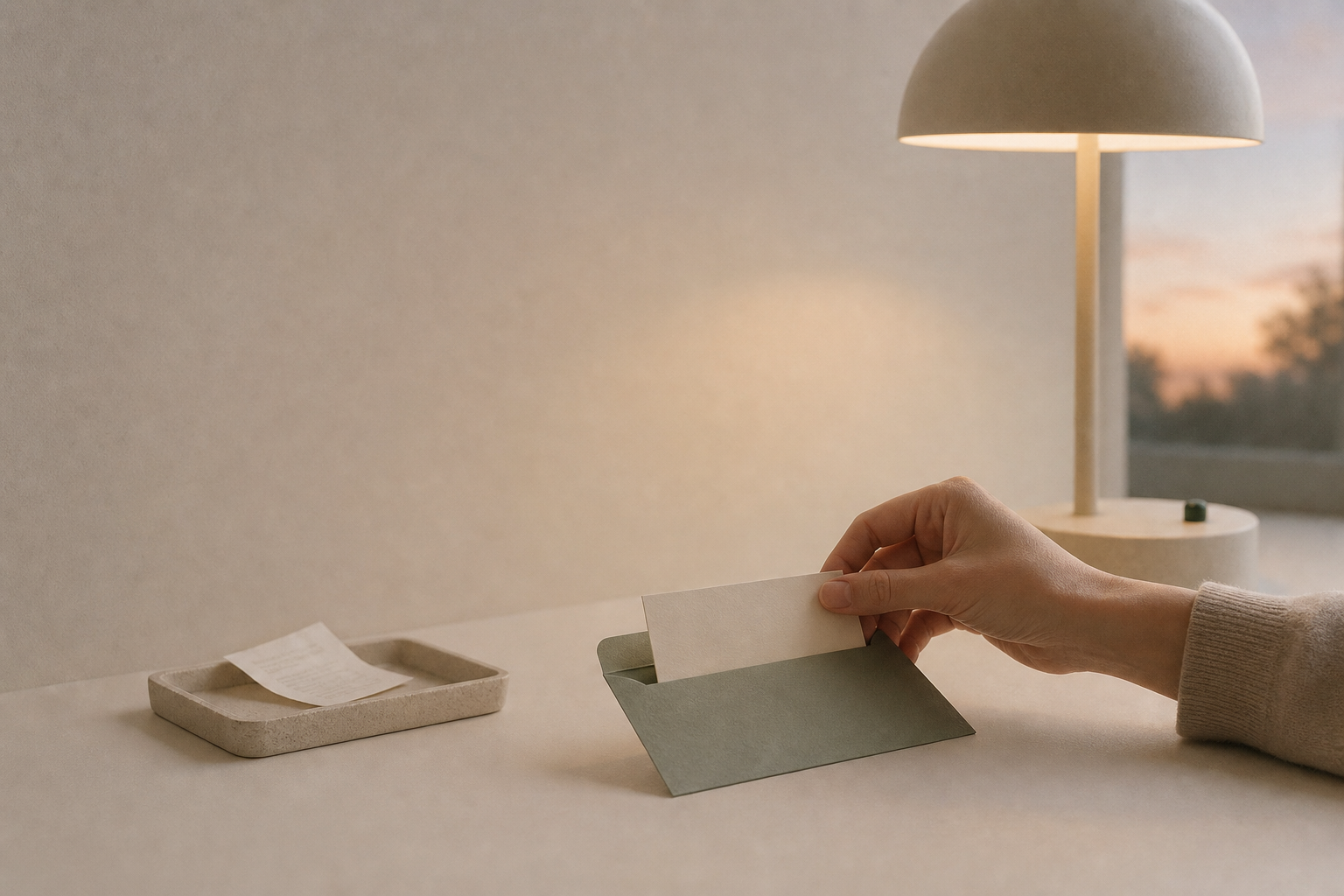
4. Close the paper physically
Fold the card. Clip it. Slip it into an envelope. Put it in a tray. Tuck it under a notebook only if the notebook is not itself the problem.
The gesture is small, but the body understands it.
Paper leaves a trace that screen work does not. A window can be closed and still feel open. A card in an envelope is visibly done. The difference is minor on paper and major in the nervous system.
5. Leave the desk with one sentence
The last line can be plain.
Good enough for today.
The rest belongs to tomorrow.
We can pick this up in the morning.
The sentence does not need to be clever. It only needs to sound like it came from a person who is allowed to stop.
Why this works better than a late-night scroll
A shutdown ritual is not only about getting organized. It is about restoring a boundary the day has worn thin.
A short paper list does three things at once. It offloads memory, because the brain no longer has to keep rehearsing the same fragments. It creates a visible container, because the work has a place to go. And it gives the end of the day a physical shape, which is something digital work often lacks.
That last part is easy to miss. Digital systems are excellent at continuing. They are less natural at ending. A paper card can be left on the desk and still feel closed. It can be clipped, tucked, or turned face down. The gesture matters because it tells the body that the task is not disappearing; it is being held elsewhere.
For the studio, that is the quiet point of the practice. We are not trying to build a perfect system. We are trying to make the last five minutes of the workday feel honest.
The smallest version of this
If five minutes feels too long, use three lines:
What is still open.
What starts tomorrow.
What can wait.
That is enough.
A paper shutdown does not need to be beautiful or repeatable in the productivity sense. It only needs to be there when the day starts to leak into the evening. The next time the desk feels too open, a card and a pen can do a small amount of useful work.
The day does not have to end dramatically. It only has to end clearly.
Sources and access notes
Accessed 29 July 2026.
- Cybersmile: Digital Wellbeing Report (2025)
- JMIR Mental Health: Effectiveness of Digital Mental Health Interventions in the ... (2025)
- International Journal of Human-Computer Interaction: Effect of digital technologies on employee wellbeing and ... (2025)
- ACM Digital Library: Remote Workplace Interactions and Extraversion: A Field ...
- PubMed: Drawing compared to writing in a diary enhances recall of autobiographical memories
- ScienceDirect: Drawing behaviour influences ongoing thought patterns and subsequent memory
Editorial notes
- The research claims stay narrow on purpose: these sources support offloading, recovery, and attention shifting, not a claim that paper solves burnout.
- The paper shutdown is designed as a closing ritual, not a productivity method.
- The image marker is intentionally searchable so the inline image placement can be found quickly during layout.