
Screen Time Is a Number. Attention Has a Texture.
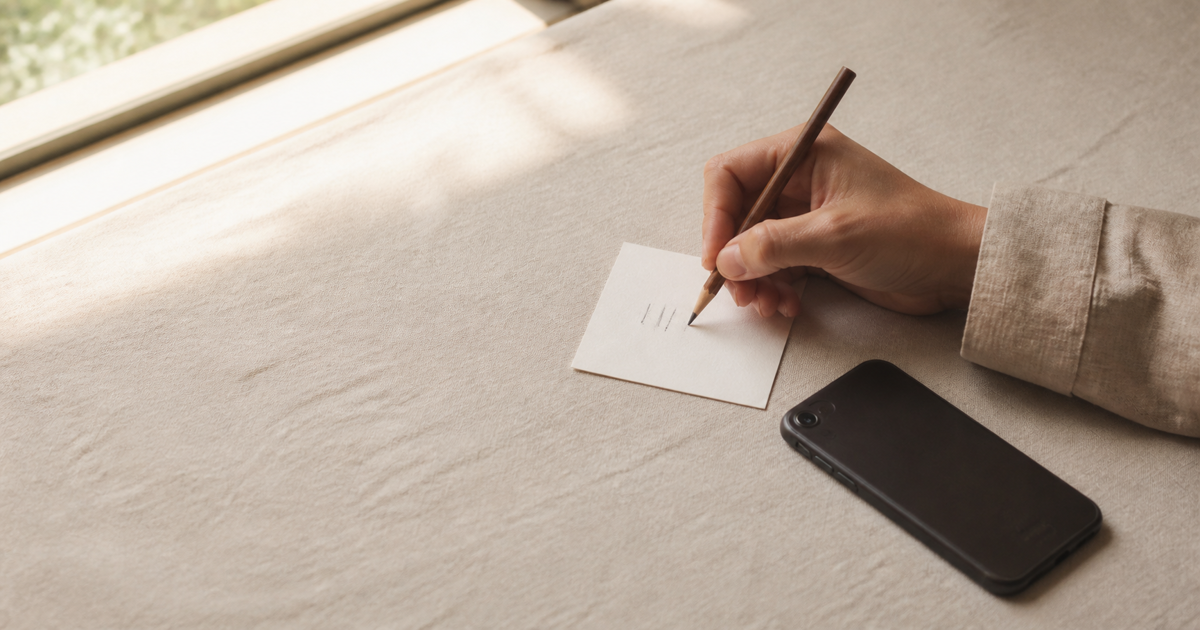
The minutes are easy to count. The shape they leave in a day is harder to see.
Once a week, the phone offers a report. The number arrives neatly rounded, often with an arrow beside it: six hours and twelve minutes a day, up nine per cent from last week.
The precision can feel like an answer. It may also feel like a verdict.
But those hours might contain a call with someone far away, directions through an unfamiliar station, a recipe balanced beside the stove, work messages, music, photographs and twenty minutes lost to a feed we did not mean to open. The total places every minute in the same container. It cannot tell us how any of them felt.
A number without a scene
Screen time is useful for one plain reason: it can be counted. That makes it easy to compare one day with another. It is much harder to measure whether attention felt chosen or pulled, continuous or repeatedly broken, settled afterwards or faintly scattered.
Even our estimate of the number can be unreliable. A preregistered meta-analysis compared self-reported digital media use with device logs across 106 effect sizes. Self-reports were only moderately correlated with logged use and were rarely an accurate match. The screen-time panel gives us a better count than memory does. It still gives us only a count.
At the studio, we like paper partly because it makes an action visible. That preference does not turn a sheet of paper into a cure, or a phone into the cause of every distracted afternoon. The more useful question is smaller: what kind of attention did this tool invite today?
What a large adult study found
A 2025 study in Proceedings of the National Academy of Sciences examined around 250,000 days of objectively recorded smartphone use from 10,099 adults across the United States. Participants were followed for four weeks. The researchers compared social and non-social app use, phone unlocks and session length with daily reports of mood.
Most of the relationships were weak or absent. Some associations changed direction depending on whether one person was compared with another or with their own usual pattern. Age and gender explained more variation in mood than smartphone use did. The authors did not find evidence that more phone time, by itself, had a strong or causal relationship with mood over those four weeks.
This is not evidence that every kind of phone use is harmless. The study included adults using Android phones, followed them for a relatively short period and grouped apps into broad categories. It could not see the meaning of a message, the hour at which a session happened, or whether a phone interrupted dinner, work or sleep. Its value is more modest. It warns us not to treat one total as a diagnosis.
The experiment that seems to disagree
Another 2025 study asked a different question. In a month-long randomised trial, 467 iPhone users in the United States and Canada agreed to block mobile internet on their phones for two weeks. Calls and text messages still worked, and participants could use the internet on other devices.
The group assigned to block mobile internet first showed improvements in subjective wellbeing, mental health measures and an objective test of sustained attention. The later group showed a similar pattern when its turn began. Participants also reported spending more time socialising in person, exercising, reading, pursuing hobbies and being outdoors. These changes in time use appeared to explain part of the effect.
The experiment was not a simple instruction for everyone to copy. Compliance was difficult. Of the 467 people who agreed to take part, 119 met the researchers' preregistered threshold for keeping the block active. The sample included only iPhone users, attrition was substantial, and the waitlist group knew it would receive the same intervention later. The results are interesting, but they do not prove that two offline weeks will help every person in the same way.
Both findings can be true
The large observational study asked whether the amount of phone use moved together with mood. The experiment changed constant access to mobile internet and watched what happened to attention, wellbeing and the rest of the day.
Those are different questions.
The experiment also changed where time went. Some of it moved towards sleep, movement, books, nature and face-to-face company. Perhaps the important detail was not only the absence of a screen. It was the return of activities that had been crowded out.
A 12-week study of 187 university students offers another useful limit. Weeks with more device-logged phone use did not predict worse moods at the end of those weeks. Yet the researchers could not examine late-night use or moments when the phone interrupted another activity. The duration was visible. The setting was not.
Attention has a texture
Two equal hours can leave different traces.
One hour may have a clear beginning and end: a video call, a film watched with full attention, a train route found and followed. Another may arrive in fragments between every other task. Five minutes while the kettle boils. Three at a crossing. Twelve after opening the phone to check tomorrow's weather.
The second hour can feel longer because it has more edges. Each return asks us to remember what we were doing before. The screen-time total does not record those returns. It also does not record whether the hour supported something we care about or quietly replaced it.
This is the texture we mean: the pattern around the minutes. Chosen or automatic. Whole or interrupted. Restful, useful, numbing, social, lonely, or simply ordinary. The same device can hold all of these in one afternoon.
A quieter way to notice
A strict digital detox can become another project to maintain. A softer observation needs only one loose piece of paper.
For a few days, leave a small card near the place where the phone usually rests. After one ordinary session, write three short fragments:
- Picked up the phone to...
- Put it down feeling...
- That time supported or replaced...
There is no daily target and no need to record every unlock. One honest moment gives more context than a perfect tally. "Directions home; clear; supported the walk" belongs beside "opened for a message; stayed for twenty minutes; replaced sleep." The point is not to make the first entry good and the second one bad. It is to see that they are different.
After several notes, a pattern may appear. Perhaps the phone is most useful in motion and most porous beside the bed. Perhaps messages feel warm while short videos leave too many loose edges. Perhaps nothing needs to change. The record can remain an observation rather than a rule.
Keep the number, add the scene
We do not need to throw away the screen-time report. It can show a change worth noticing. It simply cannot tell the whole story alone.
A number says how long. A small record can say what happened, what followed and what was missing. Together, they offer a gentler kind of digital wellbeing, one that makes room for context instead of grading the day.
Paper has a quiet role here. It does not compete with the phone or ask us to leave the digital world. It gives the experience somewhere else to become visible. Sometimes that is enough to notice the shape of an hour before it disappears into the weekly total.