
A Quiet Hobby Is Not Another Project
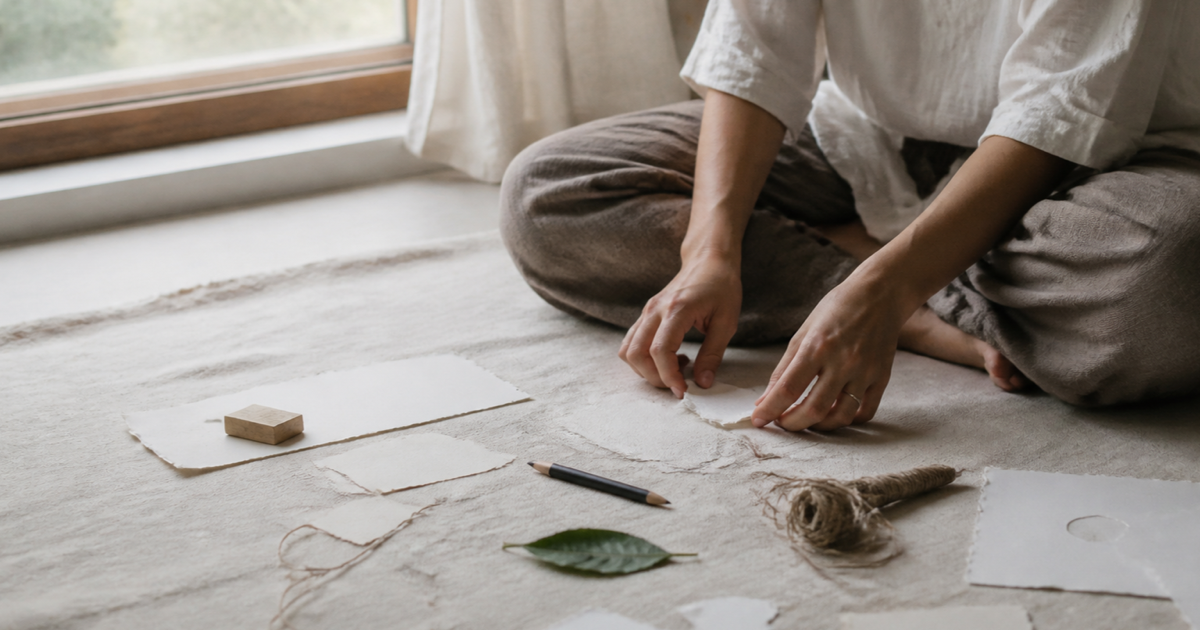
Some things can be made without becoming evidence of a well-used day.
A small box of coloured pencils sits within reach. One evening, a few colours are tested on scrap paper. Nothing is planned. The page does not need to become a drawing.
Then the rules begin to arrive. Use the pencils every week. Learn a proper technique. Complete a sketchbook. Photograph the progress. Decide whether this is a hobby worth continuing.
None of these ambitions is wrong. Learning can be satisfying, and finished work can carry its own quiet pleasure. But somewhere between curiosity and improvement, the hour begins to report upward. It needs to prove that it was useful.
At the studio, much of the day already has a brief, a deadline and a file that must be named correctly. A hobby does not have to become another branch of that system. It can be one of the few places where attention is given without asking for a return.
What the research can say
There are good reasons to take creative leisure seriously, even without making large claims for it.
A 2024 study in Frontiers in Public Health analysed survey data from 7,182 adults in England. People who had taken part in at least one arts or crafts activity in the previous year reported slightly higher life satisfaction, happiness and a stronger sense that life was worthwhile, after the researchers accounted for factors such as health, employment and demographics.
The word slightly matters. Arts and crafts explained only a very small amount of the difference in those wellbeing measures. The study was also cross-sectional: it observed an association at one point in time, so it cannot show that crafting caused the improvement.
A 2025 systematic review looked more closely at 19 craft-based interventions, including pottery, embroidery, knitting, papercraft and woodwork. Every included study reported some short-term improvement in wellbeing, but the methods varied widely and weaknesses were common. Only one study checked whether the effects were still present weeks later. The reviewers concluded that the evidence was promising, but not firm enough for broad conclusions.
The wider picture points in a similar direction. A World Health Organization scoping review brought together findings from more than 3,000 studies on the arts and health. And a 2023 longitudinal analysis of 93,263 people aged 65 and over across 16 countries found that hobby participation was associated with fewer depressive symptoms and better self-reported health, happiness and life satisfaction.
These are meaningful signals. They are not an instruction sheet.
What the research cannot ask of us
The studies do not establish a required number of minutes, a perfect medium or a streak that must be maintained. They do not turn knitting, drawing or paper craft into treatment. The large international study concerned older adults and used a broad definition of hobbies, while the English survey grouped many different arts and crafts together. People, practices and circumstances differ.
Research can remind us that leisure is not trivial. It cannot tell us that every spare hour should now be optimised for wellbeing.
That distinction is easy to lose. Once an activity is described as good for us, it can acquire a new kind of pressure: choose the right one, do it consistently and make sure it works. Rest is given another performance review.
The gentler reading is simply that making things may deserve room in ordinary life, even when the result is not exceptional and the benefit cannot be measured at the end of the evening.
The point may be the making
Paper offers a small resistance when it is folded. Thread changes direction around a fingertip. A pencil leaves a darker mark when the hand slows down. These are modest events, but they return attention to material, weight and touch.
We read this as a possible reason quiet hobbies can feel different from the rest of a busy day—not as a mechanism proven by the studies, but as an observation from studio life. The hands meet a real surface. A choice has a visible consequence. The scale of the task becomes human again.
And unlike paid creative work, the making does not need to resolve into a deliverable. A crooked paper shape can stay crooked. Three stitches can be enough for tonight. The pleasure may live in the contact rather than the outcome.
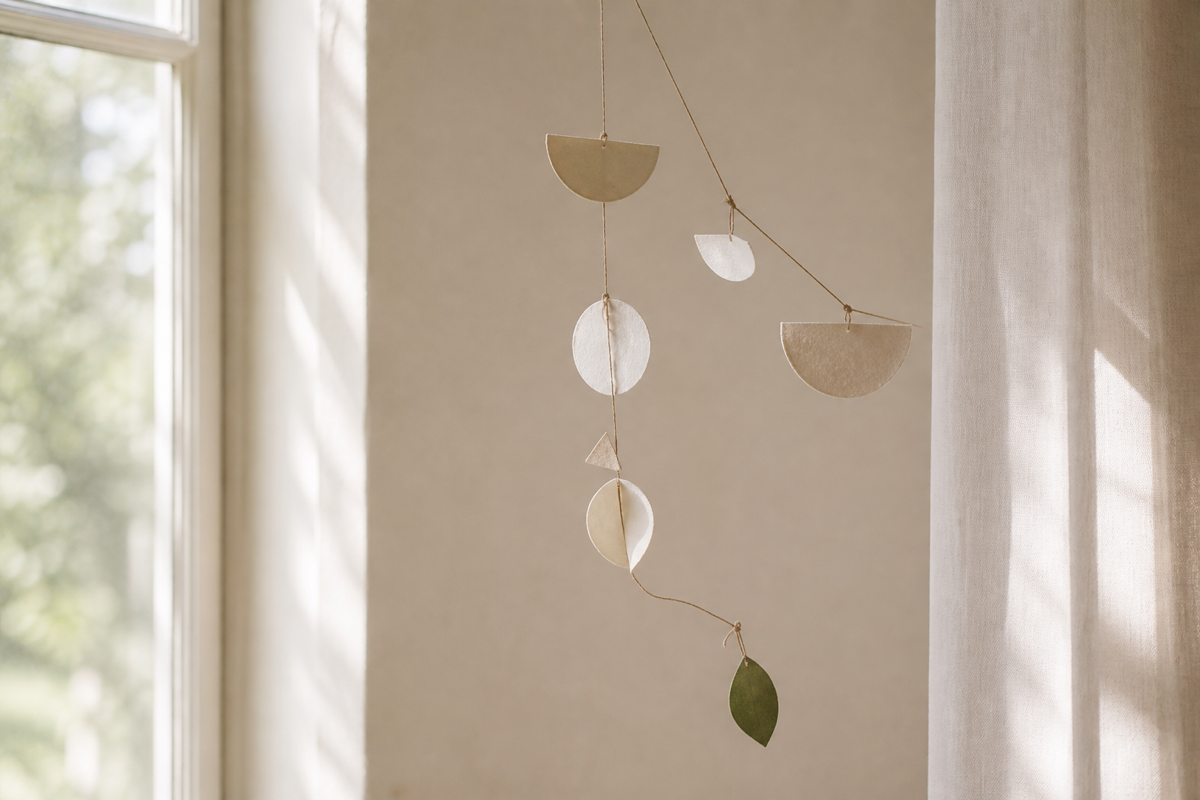
Leave one corner unmeasured
A quiet hobby does not need an elaborate routine. It may only need a shallow tray that can be brought to the table, or a small bundle of materials left where the hand can reach them.
It does not need a streak. If it returns after three weeks, it has not failed; it has simply been waiting.
It does not need an archive. Some experiments can be recycled, unravelled or returned to the materials box. Not every object needs to become evidence.
And it does not need an audience. Sharing is not the problem, but it changes the room. The eye begins to anticipate the photograph, the caption and the response. Keeping one version private can protect the uncertain stage where taste is still forming and play has not yet learned to pose.
For those of us whose work already involves making, this private corner can be especially important. It lets creativity exist before usefulness. It reminds the studio that not every idea is inventory, content or a future product.
An unfinished thing can still be complete
Near the end of the day, a strip of paper may still be waiting for another fold. A length of thread may remain attached. The object is unfinished in the ordinary sense, but the hour itself has already done enough.
A hobby is allowed to stop because the light changed, because the hands are tired or because interest wandered elsewhere. It can end without a conclusion and begin again without a plan.
This is a different kind of completion: not the completion of the object, but of the time spent beside it. Nothing was improved for display. Nothing was converted into proof. Something was simply touched, noticed and left with room to continue.