
Why Small Paper Rituals Are Easier to Return To
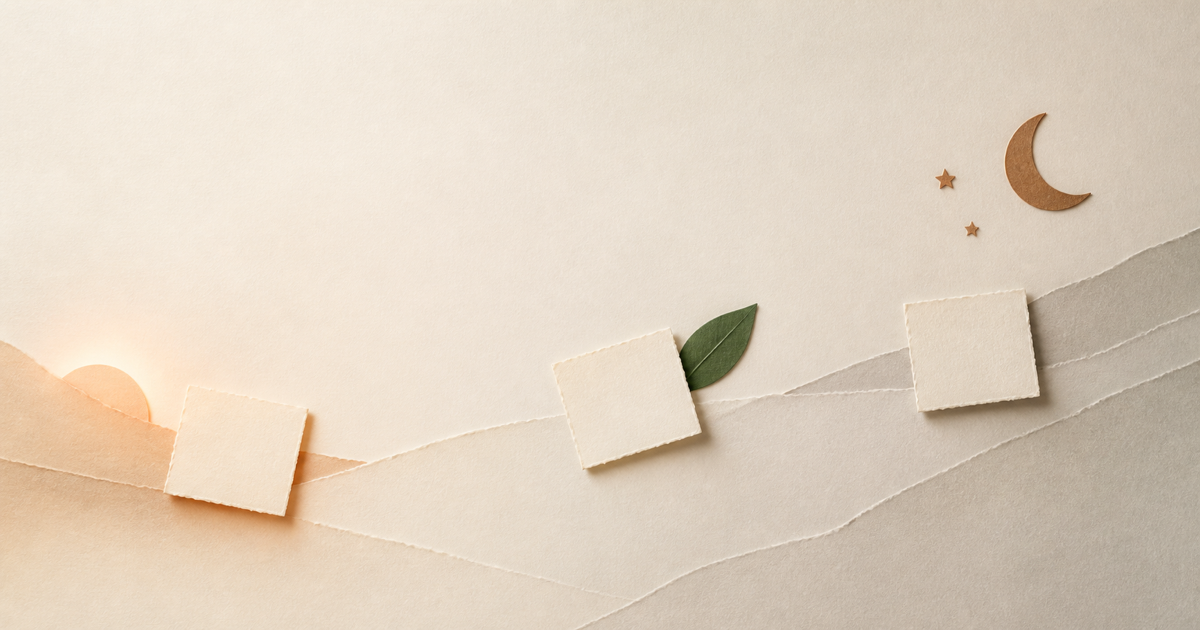
Some routines are built for our most organised days. They ask for a full page, a clear desk, twenty quiet minutes and the right frame of mind. Then a busy week arrives. The routine disappears, and restarting it feels strangely larger than beginning it did.
A small paper ritual asks for less. It might be one sentence written on a loose card after breakfast, a pencil mark beside the kettle, or a scrap of paper folded before the studio closes. The action is modest enough to fit inside an ordinary day. More importantly, its cue can remain in view while life moves around it.
That is what makes the return interesting. Not the perfect streak, but the small door left open after we miss a few days.
A cue can be smaller than motivation
Habit research often describes automatic behaviour as a response to context. A place, time, object or preceding action begins to prompt what comes next. In a 2022 study of context stability, people who repeated a chosen behaviour in more consistent circumstances developed stronger automaticity and were more likely to reach their goals. The study was not about paper rituals, but its finding is useful here: a stable cue can carry some of the work that we tend to assign to willpower.
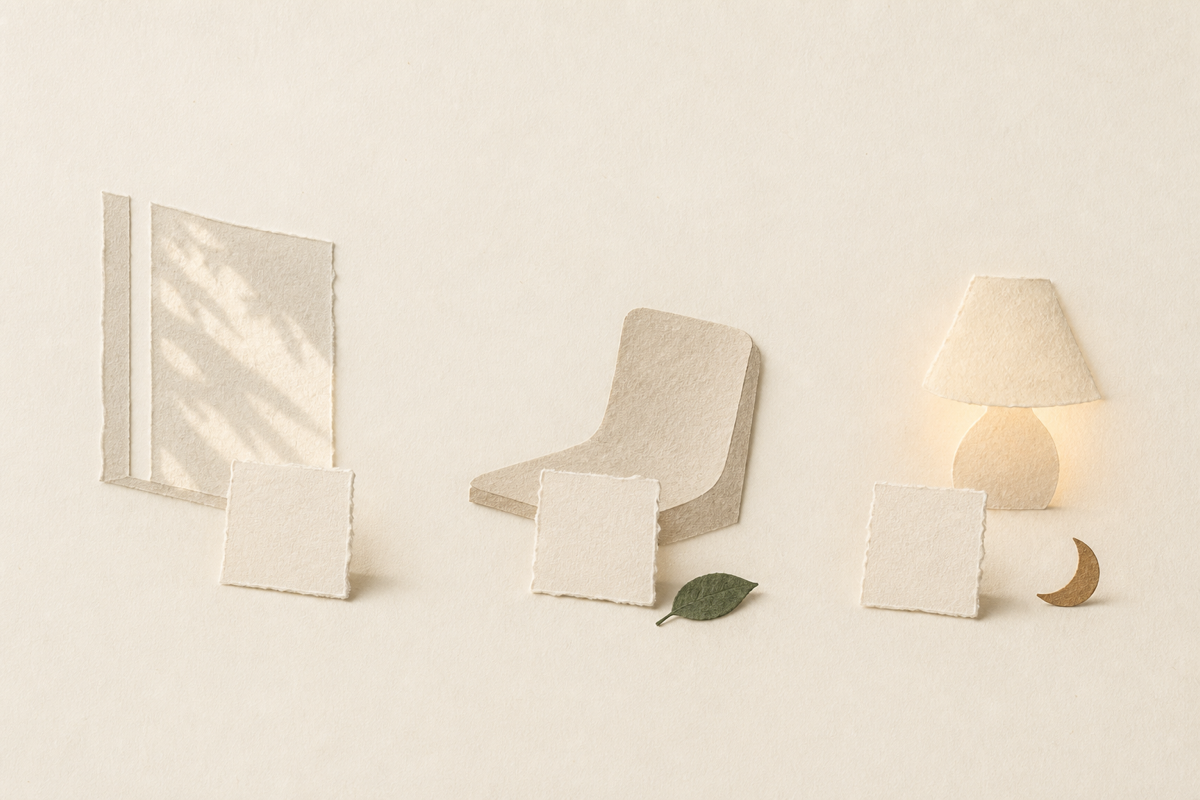
Paper makes a particularly plain cue. A card can sit beside the tea tin. A narrow list can wait inside a pencil case. A folded note can rest by the lamp we switch off each evening. There is no screen to wake, app to open or menu to remember. The paper is simply there, already connected to the setting where the action belongs.
This does not mean an analogue tool is always better. It means that a visible object can reduce the number of steps between noticing and doing. On a tired day, one fewer step matters.
What ritual adds to routine
A habit and a ritual overlap, but they are not quite the same. A habit can become automatic through repetition. A ritual also carries meaning. It gives a small action a familiar shape: the same card, the same pencil, perhaps the same moment in the day.
An integrative review of ritual research describes rituals as repeated, patterned actions that can support emotion regulation, performance goals and social connection. The meaning around the action is part of the process. For a studio, closing the day with one handwritten line may become a boundary between work and rest. For a quiet morning, circling one word may be a way to notice what deserves care.
We should not turn that into a promise that every ritual reduces stress. A preregistered experiment on ritualised behaviour did not find simple direct support for that claim. It found a more complicated pattern: stress increased repetitive behaviour, and greater repetition was associated with lower physiological arousal. Small rituals may help, but their effect depends on the person, the context and what the action has come to mean.
Keep the action close to the cue
The most returnable paper ritual is often attached to something that already happens.
After the kettle clicks off, write one line. When the studio light comes on, choose one small priority. Before a book goes back on the shelf, mark the sentence worth keeping. The existing moment provides the cue; the paper gives it a place to land.
It also helps to keep the materials almost comically simple. One card and one pencil are enough. If the ritual requires finding a particular notebook, clearing a surface and deciding how the page should look, preparation begins to outweigh the action. We can save the beautiful, spacious pages for days that have room for them. A daily ritual needs to survive Tuesday afternoon.
Make it easy to finish
The usual advice to “build a habit” can make a tiny practice feel like a permanent contract. Research offers a less tidy picture. A 2024 systematic review found wide variation in how long health-related habits took to become automatic. Median estimates in the included studies were around two months, but individual times ranged from a few days to many months. Timing, frequency, context and whether people chose the behaviour themselves all mattered.
That variation is reassuring. There is no single clock we are failing to follow.
For a paper ritual, a useful measure may be smaller than automaticity. Can we complete it without negotiation? Can we return after a gap without needing to catch up? One dot, one word or one sentence gives the action a clear edge. When it is finished, it is finished.
This is also why we prefer not to backfill missed days. Empty dates are not debts. If the card has been untouched since Thursday, Monday can begin on Monday. The ritual keeps its size instead of becoming an archive project.
Three rituals with a low point of entry
The form matters less than the ease of returning. These are small enough to try without redesigning the day:
A one-line arrival
Keep a loose card where work begins. Write the next kind action, not the whole task list: test the pale paper, answer the oldest message, trim one sample. The card is complete after one line.
A paper pause
Place a small square near a regular afternoon cue. Add a dot, short mark or single word for how the day feels. No explanation is required. Over time, the marks become a quiet record without asking us to keep a formal journal.
A closing fold
Before leaving the desk, write down what can wait until tomorrow and fold the paper once. The fold gives the workday a physical ending. In the morning, the same slip can provide the first cue.
None of these needs to happen every day to remain useful. Their value is partly in being recognisable when we come back.
Leave the way back visible
We often make routines harder to resume by hiding their evidence. The notebook returns to a drawer. The materials are tidied into a box. The app notification is dismissed. When the wish to restart appears, there is no obvious first move.
A small paper ritual can wait differently. It can remain on the tray, clipped to a calendar or tucked beside an object we already reach for. Not as a rebuke, and not as another unfinished task. It is a quiet invitation with a known beginning and a small ending.
At the studio, we think a good paper practice should make room for interruption. Life will interrupt it anyway. The kinder design question is whether the practice still knows how to welcome us back.