
A Small Record of an Ordinary Day
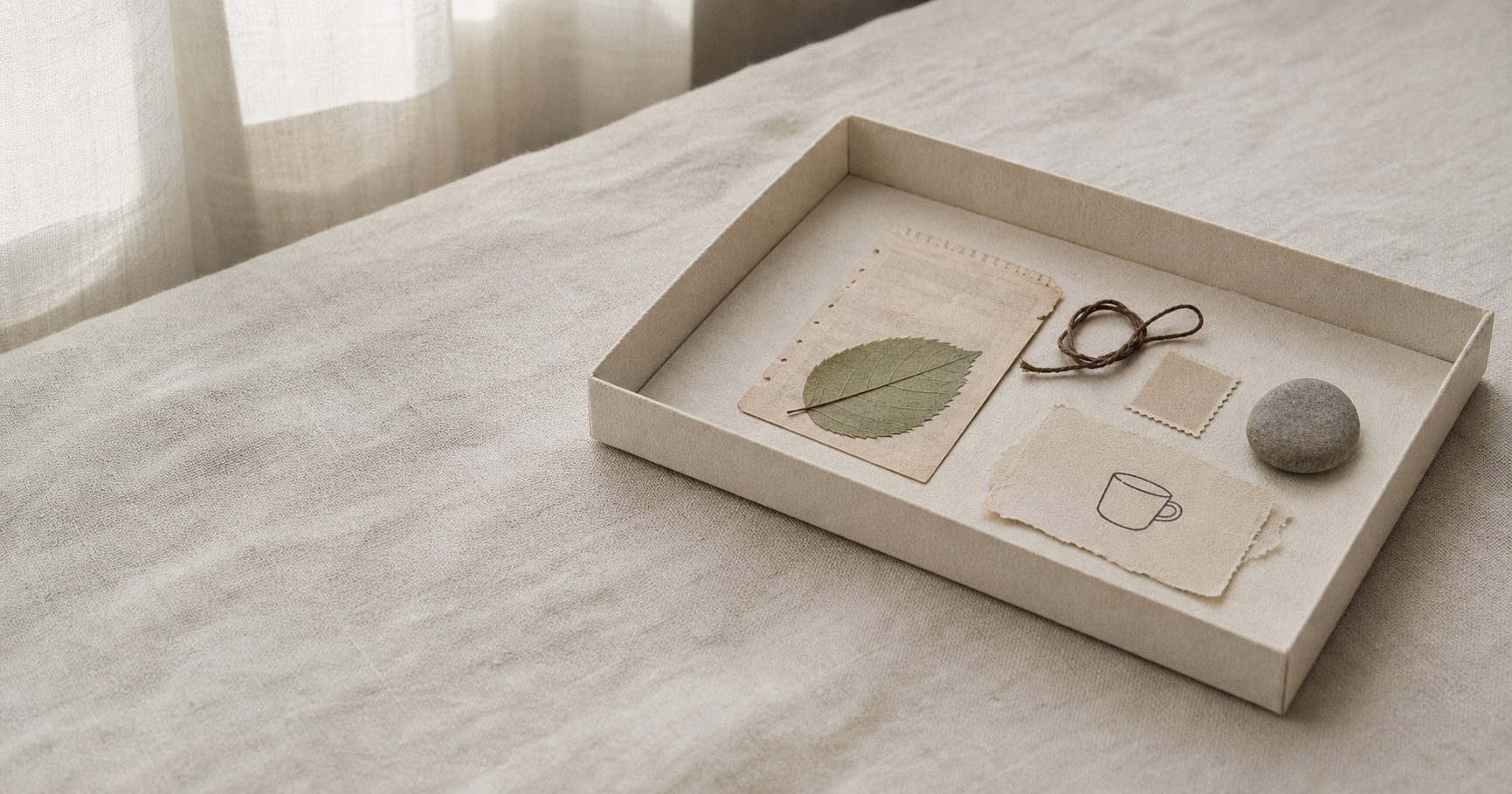
A few words, a small drawing, and something the day almost carried away.
Some days arrive with a date we already know we will remember. A journey begins. Someone moves away. A long-awaited parcel appears at the door.
Most days do not announce themselves.
The kettle clicks off. A green umbrella dries by the door. Someone on the train is carrying a paper bag of peaches. By evening, none of it seems important enough to write down.
Then time passes, and these are often the details we wish had stayed.
The things that disappear first
Memory is good at leaving us with the shape of a period: the difficult winter, the summer of a new job, the year a familiar shop closed. It is less reliable with the small texture inside that shape.
In a study of everyday memory, researchers recorded people walking through real environments and later tested their recognition of what they had seen. Participants retained surprisingly little of the moment-by-moment detail. The researchers were studying controlled routes rather than whole lives, but the finding feels familiar. A day can remain in memory while most of its furniture disappears.
That forgetting is not a personal failure. A mind cannot keep every window, sentence, receipt, cloud and cup. It lets the day become lighter so the next one can enter.
A record gives one detail somewhere else to stay.
What seems ordinary now may not feel ordinary later
Researchers Ting Zhang, Tami Kim, Alison Wood Brooks, Francesca Gino and Michael Norton asked people to create records of their present lives and predict how they would feel when they encountered those records later. Across four studies of rediscovery, people underestimated the curiosity and pleasure of rediscovery. The gap was especially clear for experiences that had seemed mundane when they were first documented.
An ordinary day is easy to dismiss because it is still close. The route home feels permanent. The view from the kitchen looks the same as yesterday. We assume the detail will remain available because it is available now.
Usually, it does not.
This does not mean every hour needs to be preserved. A complete archive would soon become another form of noise. The gentler possibility is a small record: one detail chosen before the rest of the day moves on.
One detail is enough
Journaling can quietly turn into a performance. The page asks for a full account, the handwriting begins to matter, and an empty date starts to look like a broken promise.
A small record has less to prove. It may look like this:
28 July
Cicadas before breakfast.
The drinking glass felt cold.
A green umbrella dried by the door.
Nothing happened in those four lines. That is part of their value. They hold the day before it has been edited into a lesson.
At the studio, we like records that can fit on a loose piece of paper. A narrow insert, the back of a receipt, or a card kept in a box can hold enough. The form stays small, so missing a day does not create a gap that needs explaining.
There is no streak to protect. The next record begins whenever another detail asks to stay.
A loose shape for beginning
When a blank card feels too open, one small doorway can help. We might record something seen, something heard, or something felt against the skin. The red paper lantern outside a restaurant. A neighbour practising the same bar of music. Cool tiles under bare feet.
These are not prompts to complete in order. They are simply ways into the day. A date and one detail may be the whole record. On another evening, the detail may ask for a colour, a second line, or a tiny drawing beside it. The page can decide its own size as we make it.
Some records will feel flat when they are new. They do not need to become meaningful immediately. Their work is only to remain available.
A drawing keeps a different kind of detail
Words are not the only way to make a record. A small drawing can hold the tilt of a cup, the shape of a leaf, or the way a coat folded over the back of a chair.
In one diary study, 30 younger and 30 older adults recorded randomly chosen daily events over two weeks. They alternated between writing about an event and drawing it. When researchers later prompted them to recall the events, the memories first recorded through drawing were matched more accurately, and their level of detail was better maintained.
Another pair of preregistered experiments compared drawing and writing while participants learned words. Drawing led to better recall and to thoughts that were more visual and elaborative. That study was not about personal journals, so it cannot tell us that every sketched day will be remembered perfectly. It does suggest that drawing changes the way attention gathers around a detail.
The drawing itself can stay modest. Three lines for a cup. A dark square for the window after rain. The point is not to make the day look beautiful. It is to notice what shape it had.
A page can be a place of return
Photographs preserve more visual information than a sentence or a sketch. They are useful, and often dear to us. But a small paper record carries the trace of a decision: out of everything present, this was the part we stopped to notice.
That choice gives the record its shape. The peach bag instead of the whole train. The sound of cicadas instead of the whole morning. The umbrella rather than the weather report.
Months later, the page may bring back more than it contains. A few words can return the room around them. A crooked drawing can return the hand that made it, the chair beneath it, or the five quiet minutes before the day continued.
The ordinary moment was never empty. It was simply too close to see from the future.
So the page waits.
Not with a complete account. Just enough for one day to say: this happened. We were here.