
Beyond Paper and Leather: Deconstructing the Mechanical "Snap" of Japan's Premium Ring Planners
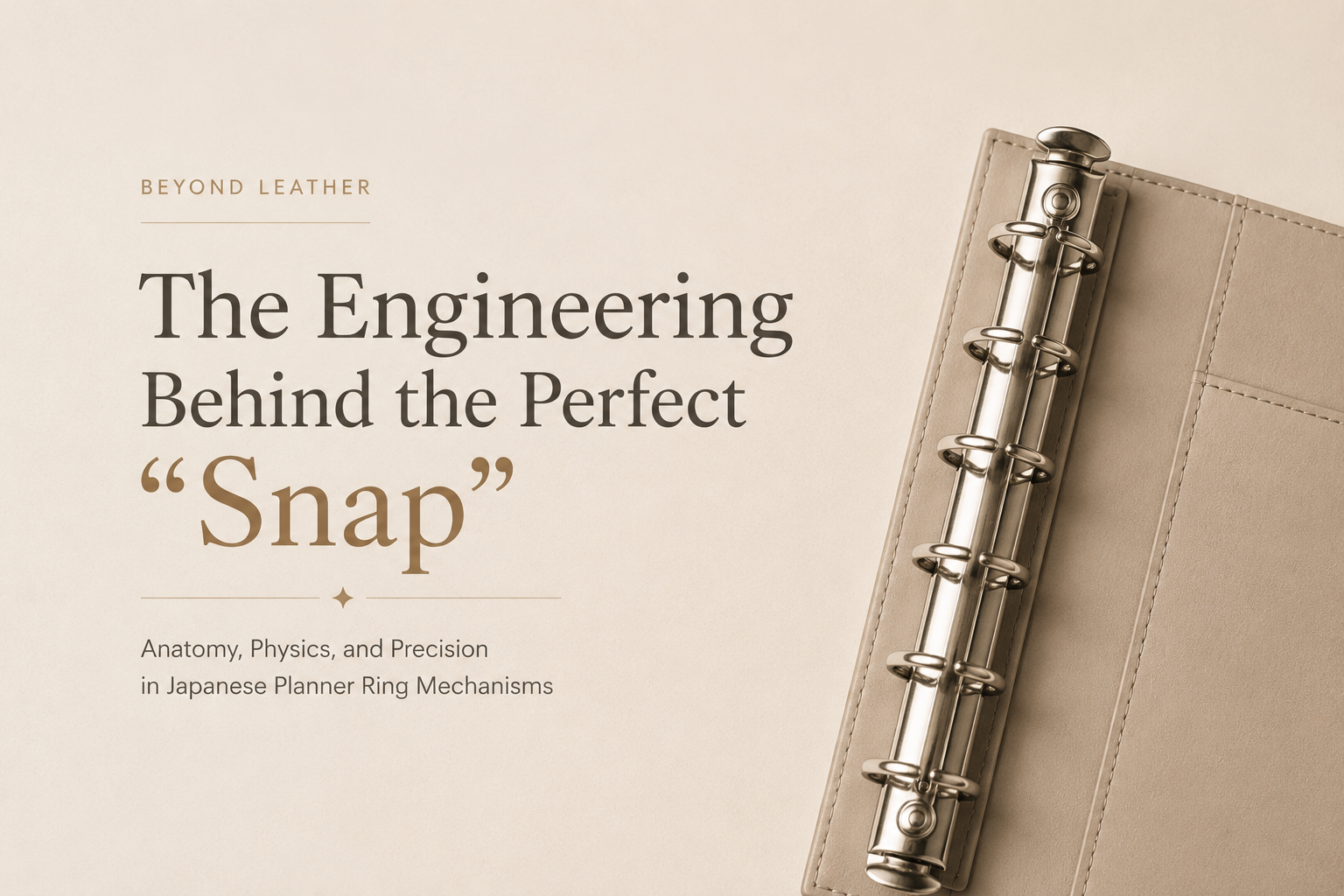
If you spend any amount of time in the analog stationery community, you have undoubtedly encountered them. They dominate Instagram feeds and YouTube desk setups: the sleek Plotter Pueblo, the robust Raymay Davinci Roroma Classic, the elegant Ashford Neofinard, and the timeless Knox Pearce.
You have also, inevitably, seen the price tags.
For many Western planner enthusiasts accustomed to standard office-supply binders or mass-market fashion planners, seeing a 6-ring binder priced at $150, $250, or even north of $400 can induce a sudden wave of sticker shock. The immediate, reflexive justification provided by aficionados is almost always about the exterior: "It is the quality of the leather." They will speak of Italian Pueblo, genuine Cordovan, or oil-tanned cowhide from Himeji that takes months to cure.
But while the leather is undeniably exquisite, it is only half the story. To attribute the cost of a high-end Japanese system techo (organizer) solely to its cover is to fundamentally misunderstand what you are buying.
The true secret—the core engine that separates a generic binder from a generational heirloom—lies hidden in the spine. It is the ring mechanism.
To the untrained eye, a 6-ring binder mechanism is a mundane piece of stamped metal, a utilitarian object designed simply to hold punched paper. However, from a mechanical engineering perspective, the mechanisms housed inside top-tier Japanese planners are precision instruments. They are micro-engineered toggle systems built with exacting tolerances, acoustic tuning, and advanced material science.
If you are currently using a standard ring planner and wondering why you should upgrade, or if you are simply curious about why these Japanese tools command such a premium, it is time to look past the leather. We are not doing a standard unboxing today. We are performing a mechanical autopsy.
Here is the anatomy, physics, and engineering behind the perfect "snap."
The Anatomy of a Precision Ring Mechanism
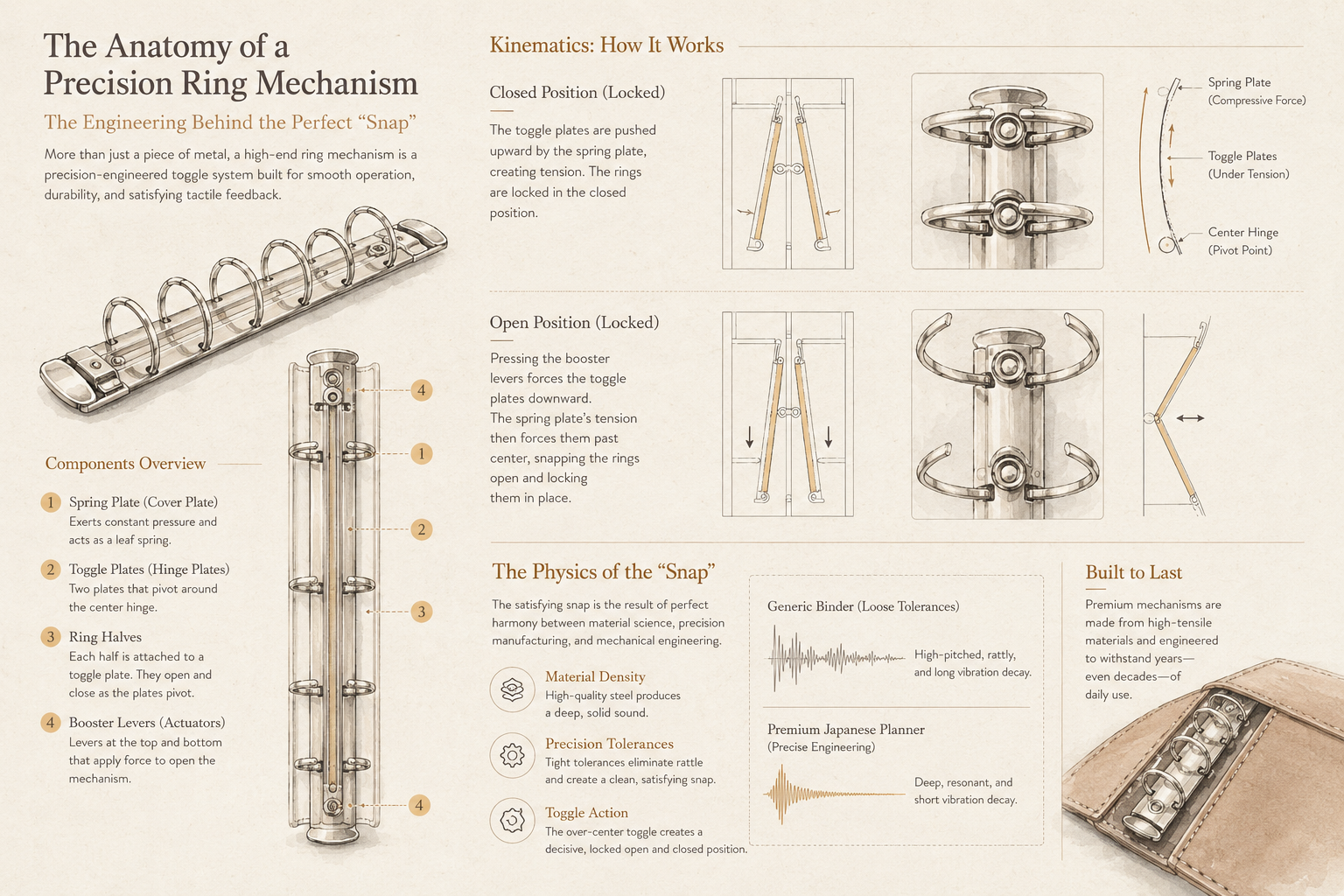
To understand why a premium mechanism feels different, we must first strip away the luxurious leather and examine the bare metal. A ring binder mechanism is not a static object; it is a dynamic, kinetic assembly known in mechanical engineering as a spring-loaded toggle mechanism.
While designs vary slightly among manufacturers (with many top-tier Japanese brands utilizing highly tuned mechanisms from legendary foundries like Krause, or engineering their own proprietary hardware), the fundamental anatomy consists of four critical components:
1. The Spring Plate (Cover Plate)
This is the visible, curved metal spine that houses the internal workings. It is not merely a protective casing; it is an active mechanical component. The spring plate acts as a continuous, longitudinal leaf spring. It is manufactured from high-tensile spring steel, designed to constantly exert downward compressive force on the internal components.
2. The Toggle Plates (Hinge Plates)
Hidden entirely beneath the spring plate are two flat, elongated metal strips running the entire length of the binder. These two plates meet in the center, forming a longitudinal hinge. They are the heart of the toggle mechanism.
3. The Ring Halves
The rings themselves are not solid circles. They are pairs of half-rings, typically with a circular or D-shaped cross-section. One half of each ring is rigidly welded or riveted to the left toggle plate, and the mating half is attached to the right toggle plate.
4. The Booster Levers (Actuators)
These are the tabs located at the top and bottom of the spine. When you press them, they act as levers, applying mechanical force to the ends of the toggle plates.
The Kinematics of the Open and Close
When the rings are closed, the two toggle plates sit at a slight upward angle (like a shallow roof), held in a state of high tension by the compressive force of the curved spring plate above them.
When you press the booster levers, you are applying leverage that forces the center hinge of the toggle plates downward. As the hinge passes the horizontal "center" point, the geometry flips. The spring plate's tension suddenly forces the toggle plates into a downward angle. Because the ring halves are attached to these plates, they are violently and instantly thrown apart. The rings are now locked open.
Pinching the rings closed reverses the process, pushing the toggle plates back up past the center point, where the spring plate violently snaps them back into the closed, locked position.
In a $10 mass-market binder, these components are stamped from cheap, thin-gauge steel with loose manufacturing tolerances. The result is a mushy, unpredictable action. In a $250 Japanese planner, these components are machined from high-density alloys, tempered for exact tension, and assembled with microscopic precision.
The Physics of the "Snap": Acoustics and Tactile Feedback
If you hand a premium Japanese planner to a mechanical engineer, the first thing they will do is open and close the rings. They are listening to the acoustics and feeling the kinetic feedback.
The sensory experience of operating a high-end ring mechanism is profoundly satisfying. It is the difference between closing the door of a cheap economy car and closing the door of a luxury German sedan.
In a generic binder, opening the rings produces a hollow, rattling ping, followed by a metallic reverberation. This is the sound of thin metal vibrating and loose tolerances allowing components to rattle against each other.
In a premium planner from Knox or Ashford, opening the rings produces a deep, resonant, authoritative clack. There is no rattle. There is no lingering vibration. It is a singular, decisive acoustic event.
This acoustic signature is not an accident; it is the result of deliberate engineering:
- Material Density: Premium mechanisms utilize thicker gauge steel or brass. The higher mass of the metal lowers the resonant frequency, turning a high-pitched ping into a low-pitched thud.
- Tension Tuning: The spring plate is tempered to provide a very specific resistance curve. It requires deliberate, intentional force to actuate the booster levers—preventing accidental deployment in your bag—but once the toggle plates pass the center point, the kinetic energy release is instantaneous and absolute.
- Acoustic Dampening: The way the metal mechanism is seated against the leather spine plays a crucial role. High-end Japanese manufacturers use specific riveting techniques and backing materials that absorb high-frequency vibrations. The leather acts as an acoustic dampener, leaving only the satisfying mechanical snap.
The tactile feedback is equally important. When you close the rings of a premium mechanism, you can feel the exact millisecond the toggle plates lock into place. There is no "mushiness" or ambiguity. It is a binary state: it is either fully open or fully, securely closed.
Zero Tolerance: The Perfect Mesh
Perhaps the most critical point of failure in any ring planner is the "mesh"—the exact point where the two ring halves meet when closed.
If you look closely at the tips of the ring halves, they are not flat. They feature interlocking, hook-shaped profiles, often referred to as teeth. When the rings snap shut, these teeth must interlock perfectly to create a seamless, continuous loop.
In lower-quality binders, the longitudinal stability of the toggle plates is poor. Over time, or under the stress of a heavy paper load, the plates shift laterally. This results in rings that develop an "underbite" or "overbite," or worse, a visible gap where the teeth fail to meet.
For the Western planner user, a slight gap might seem like a minor cosmetic annoyance. But in the Japanese stationery world, it is a catastrophic failure. Why? Because of the paper.
Japanese planner enthusiasts heavily favor ultra-thin, high-performance papers like Tomoe River paper (often weighing a mere 52gsm). If there is even a fraction of a millimeter of misalignment or a microscopic burr at the ring mesh, this delicate paper will snag, catch, and tear when turning the pages.
To prevent this, Japanese quality control demands zero tolerance at the mesh point.
The toggle plates in premium mechanisms are engineered with strict longitudinal constraints. They are seated within the spring plate so tightly that lateral movement is mathematically impossible. Furthermore, the interlocking teeth are machined with such precision that when they close, the seam is practically invisible to the naked eye. You can run your fingernail over the closed joint of a Plotter or Davinci ring, and you will barely feel the transition.
This zero-tolerance engineering ensures that even if you drop the planner, or if you stuff it to maximum capacity, the rings will not misalign. Your delicate Tomoe River inserts will glide over the rings as smoothly as if they were turning on a solid, unbroken wire.
Material Science and Leather Integration
The final piece of the engineering puzzle is how this cold, rigid metal hardware integrates with the soft, organic, pliable nature of leather. It is at this intersection that Japanese brands truly showcase their innovative design philosophies.
Plotter's Minimalist Structural Engineering
The brand Plotter (a subsidiary of Knox) revolutionized the system techo market by completely rethinking the structural relationship between the metal and the leather. Traditional binders hide the spine hardware behind layers of leather and thick cardboard stiffeners to give the binder shape.
Plotter stripped all of that away. They utilize a proprietary, ultra-slim 11mm ring mechanism paired with a solid metal backplate (often made of raw copper or matte black steel) that is exposed on the outside of the leather cover.
This is not merely an aesthetic choice; it is a brilliant piece of structural engineering. By sandwiching a single, unlined piece of premium leather tightly between the internal ring mechanism and the rigid external backplate, Plotter eliminates the need for internal cardboard stiffeners. The metal backplate provides 100% of the longitudinal rigidity. This allows the planner to be astonishingly thin, incredibly lightweight, and capable of lying completely, perfectly flat on a desk from day one. It is a masterclass in minimalist mechanical design.
Raymay Davinci's Load Distribution
On the opposite end of the spectrum is the Raymay Davinci Roroma Classic, a planner famous for its robust, traditional, "beefy" aesthetic, often featuring larger 15mm or 20mm rings.
When you have large, heavy metal rings clamping down inside a leather cover, the mechanical pressure of the rings pressing against the inside covers when closed can cause permanent, unsightly indentations in the expensive leather.
To solve this, Raymay engineers integrated "ring guards"—thick, padded strips of leather that run parallel to the ring mechanism. When the planner is closed, the metal rings rest against these padded guards rather than the flat cover. This distributes the mechanical load, protecting the structural integrity and aesthetic beauty of the leather over decades of use.
Advanced Surface Treatments
Finally, the metal itself is treated with advanced surface finishes. You will rarely see cheap, flaking chrome on a premium Japanese planner. Instead, you will find rose gold electroplating, matte black powder coating, or raw, uncoated brass. These finishes are applied using techniques designed to withstand the intense, localized friction of metal-on-metal contact at the hinge points, ensuring that the mechanism doesn't just work flawlessly, but looks immaculate while doing so.
Conclusion: A Tool for Life
When you purchase a premium Japanese ring planner, you are certainly paying for world-class leather. You are paying for the artisans in Himeji who spend months tanning cowhide, and the craftsmen who burnish the edges by hand.
But you are also paying for the unseen engineering. You are paying for the high-tensile spring steel, the zero-tolerance machining of the interlocking teeth, the acoustic tuning of the toggle plates, and the structural integration of the metal spine.
You are paying for the guarantee that on the 10,000th open-and-close cycle, the rings will mesh as perfectly, and snap as authoritatively, as they did on day one.
A generic binder is a disposable container for paper. A Japanese system techo is a precision mechanical instrument wrapped in luxury. It is a tool designed not just to organize your life, but to outlast it. And once you understand the engineering behind that satisfying clack, the price tag suddenly makes perfect sense.